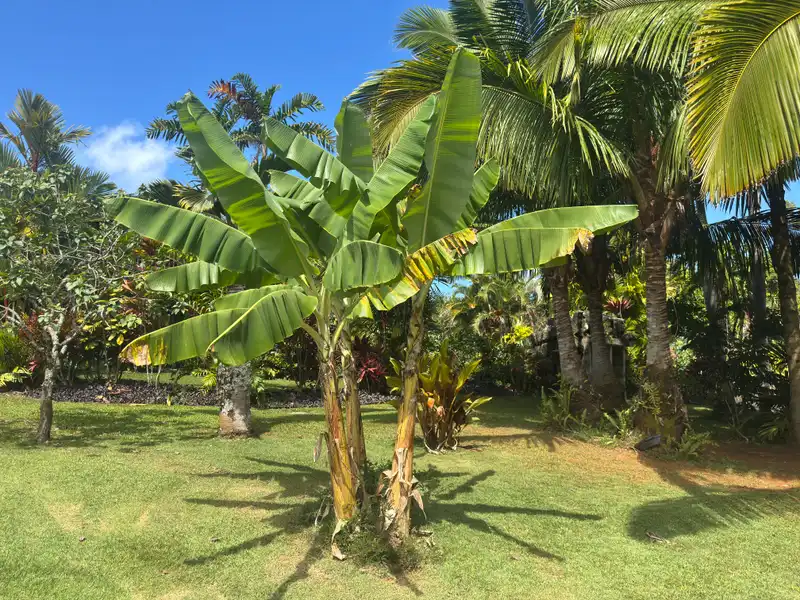
Banana (Musa spp.)
Musa
A diverse genus of giant perennial herbs with broad leaves and pseudostems formed by overlapping leaf sheaths. Bananas and plantains vary widely in size, cold tolerance, and fruit use.
- Plant Type
- House Plants & Tropicals
- Width
- Variable; often 6–10 ft
- Height
- Variable; often 7–20 ft
- USDA hardiness zone
- 10 - 11
- Sun requirements
- Full Sun, Part Shade
- Water requirements
- High
- Design image count
- 2
Design images (2)


Bring your vision to life
The design images above are drag-and-drop ready — place this plant on a photo of your own yard and see it before you plant it.
Create design onlineAbout Banana (Musa spp.)
Bananas and plantains belong to Musa, a diverse genus of giant perennial herbs rather than woody trees. Their leaf sheaths form a pseudostem above an underground rhizome; after a shoot flowers, it dies back while new growth can arise from the base ([Kew Plants of the World Online](https://powo.science.kew.org/taxon/urn:lsid:ipni.org:names:327926-2/general-information)).
## Growth and use
Musa includes many species and cultivated forms, so mature size, fruit quality, and cold response vary. Some cultivated bananas produce sweet fruit eaten fresh; others are grown as plantains or cooking bananas. The genus also has large, tropical foliage and can be used as a leafy screen in suitable climates. This entry is identified only to genus, so its existing size and hardiness ranges should be treated as variable rather than cultivar-specific.
## Growing conditions
For cultivated bananas in Florida, UF/IFAS recommends warm conditions, fertile soil, abundant moisture, and protection from frost; that guidance does not apply uniformly to every Musa species or climate. Match care to the identified species or cultivar and local conditions ([UF/IFAS, Banana Growing in the Florida Home Landscape](https://edis.ifas.ufl.edu/publication/MG040)).
## Maintenance
Remove spent flowering shoots after fruiting and retain healthy basal growth where a renewing clump is desired.