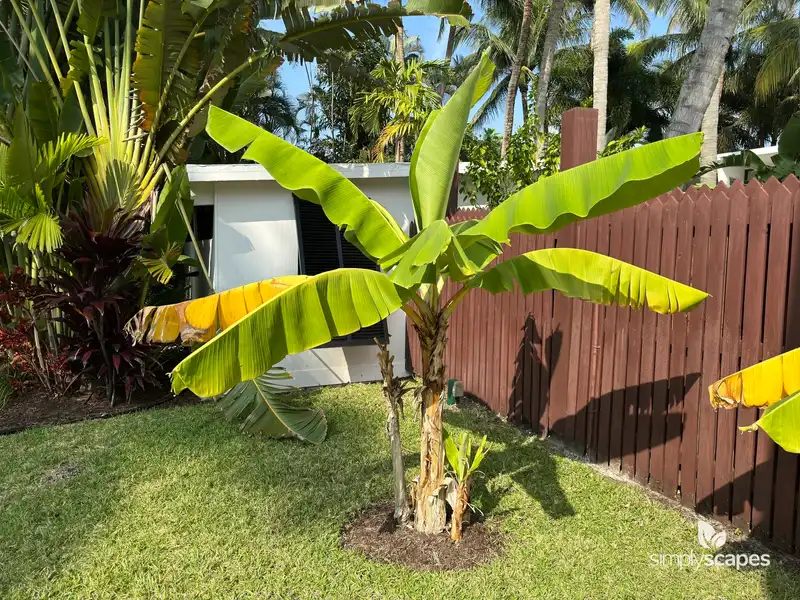
Cavendish Banana
Musa acuminata
The ultimate tropical centerpiece featuring massive leaves and sweet yellow fruit.
- Plant Type
- House Plants & Tropicals
- Width
- 6-8 Ft.
- Height
- 8-10 Ft.
- USDA hardiness zone
- 8 - 11
- Sun requirements
- Full Sun, Part Shade
- Water requirements
- Consistent moisture
- Design image count
- 3
Design images (3)


Bring your vision to life
The design images above are drag-and-drop ready — place this plant on a photo of your own yard and see it before you plant it.
Create design onlineAbout Cavendish Banana
Bananas are fast-growing, suckering herbs rather than woody trees. Cavendish refers to a group of cultivated dessert bananas with several clones; their plant stature and fruit traits vary, so this general profile does not identify one particular clone. The large leaves and edible bunches make the plant both a tropical focal point and a food crop.
## Landscape Use
Grow the clump where its broad leaves have room and can be appreciated, or include it in a warm-climate edible garden. In frost-prone regions, use a large container that can be moved to shelter; fruiting is much less reliable in cool conditions. [UF/IFAS Extension: Banana Growing in the Florida Home Landscape](https://edis.ifas.ufl.edu/publication/MG040/pdf)
## Growing Conditions
Choose full sun for best growth and fruit production, though light shade is tolerated. Deep, fertile, well-drained soil and steady moisture support vigorous leaf and fruit development. Avoid waterlogged ground: standing water can quickly damage the plant. Cold slows growth below 60°F, and freezing temperatures injure leaves and pseudostems; plants may regrow from the underground rhizome in a mild winter. [UF/IFAS Extension: Tropical and Subtropical Fruit Crops](https://edis.ifas.ufl.edu/mg373)
## Maintenance
Remove the pseudostem after it has fruited, since it dies after bearing, and thin excess suckers to keep the clump manageable. Wind can shred large leaves or topple taller clones, so choose a sheltered site. Keep irrigation consistent through active growth, then reduce it during cool weather without allowing the root zone to dry for long.
## New Zealand — FENZ Very low flammability
The [Fire and Emergency New Zealand directory](https://www.checkitsalright.nz/reduce-your-risk/low-flammability-plants) lists Musa acuminata / Cavendish banana with Very low flammability (main-directory entry 314). The directory's scientific cell is broad Musa acuminata, but its common name expressly says Cavendish banana. This record describes the Cavendish group, whose several clones are not individually identified. [NC State's species account](https://plants.ces.ncsu.edu/plants/musa-acuminata/) explicitly discusses Cavendish within M. acuminata. This is a qualified group association, not a claim that every wild banana or each Cavendish clone was independently assessed.
The directory includes all flammability bands; inclusion alone is not a planting recommendation. Higher bands mean more flammable and are separate from Idaho's numerical resistance scores. Source ratings remain conditional on plant condition, site and maintenance, with no guarantee of individual stock performance. Maintain appropriate spacing and water, remove dead material and follow local defensible-space guidance. No plant is fireproof; preserve other regional classifications separately.