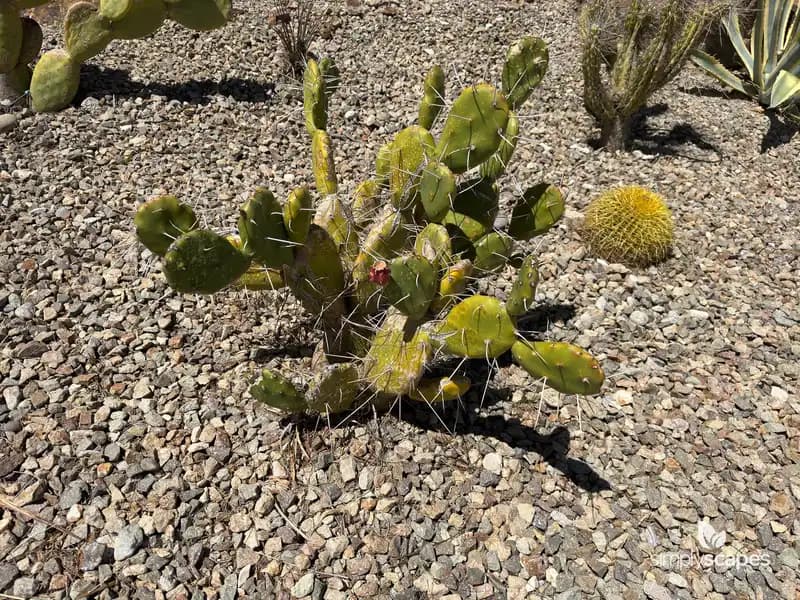
Prickly Pear Cactus
Opuntia
A diverse cactus genus with species-specific pad forms, flowers, fruit and growing needs.
- Plant Type
- Succulents
- Width
- 2-10 Ft.
- Height
- 1-15 Ft.
- USDA hardiness zone
- 4 - 11
- Sun requirements
- Full Sun
Bring your vision to life
The design images above are drag-and-drop ready — place this plant on a photo of your own yard and see it before you plant it.
Create design onlineAbout Prickly Pear Cactus
Prickly Pear Cactus represents the diverse genus Opuntia, a group of cacti with segmented pads and a wide range of forms, flowers and fruit. The genus includes many species native across the Americas, and mature size, color, climate tolerance and use differ substantially between them. [Kew’s Plants of the World Online](https://powo.science.kew.org/taxon/urn%3Alsid%3Aipni.org%3Anames%3A30002080-2) recognizes 185 accepted species, while [University of Arizona Cooperative Extension](https://extension.arizona.edu/sites/extension.arizona.edu/files/pubs/az1800-2019.pdf) describes the variation found among prickly pears.
## Garden use
Choose an identified species or cultivar before deciding where to plant: Opuntia ranges from low clumps to much larger forms, and flowers and fruit colors vary. Many species have flat, jointed pads; some carry prominent spines, while apparently spineless types may still bear tiny barbed glochids. Keep paths and play areas clear of the plant and handle pads with protective tools.
## Growing
Climate needs are species-specific across this broad genus. Choose a form suited to local winter temperatures, then provide a bright site and sharply draining soil suited to that plant. Avoid applying a single watering schedule to all prickly pears; adjust irrigation to the species, container or ground planting, and local rainfall. Some species produce edible pads or fruit, but edible use depends on correct identification and careful removal of spines and glochids.
## Maintenance
Keep the base clear of competing weeds and avoid routine handling. Use thick gloves and long-handled tools when working near pads; small glochids can detach easily and irritate skin. Confirm species-level care before pruning, moving or harvesting any plant.
The University of Arizona Firewise guide lists a broad Opuntia entry. This record represents that entry; the guide does not individually assess every species or cultivar. Follow its elevation, water, placement and maintenance guidance.
## San Luis Obispo County — January 2014
The [County-Approved Plant List](https://www.slocounty.ca.gov/departments/planning-building/forms-documents/environmental-forms-and-documents/plants-information/county-approved-plant-list) rates Opuntia varieties at F2: its most fire-retardant planting category, for 30–70 feet from a structure. This is the source’s group-level listing, not independent testing of every species or named cultivar. The source explicitly excludes O. aurantiaca. That exclusion remains part of the group’s scope, and the rating does not override local invasive-plant restrictions. Follow the county’s conditions for plant health, watering and fire-buffer design: avoid overcrowding, remove dead material, maintain separate planting groups and prevent ground-to-canopy fuel connections. Keep other regional source ratings and their placement instructions separate; the county categories are not a universal flammability scale.
## Arizona — UA elevation and care conditions (2026 audit)
The [University of Arizona guide](https://extension.arizona.edu/sites/extension.arizona.edu/files/pubs/az1289.pdf), revised December 2011, page 3, lists Opuntia spp. (cholla and prickly pear cactus) in its shrubs table. It prints water needs VL-L, sun/shade S and mature height 3 feet. Its elevation recommendations are 3,000 ft: Y; 4,000 ft: Y; 5,000 ft: Y; 6,000 ft: Y; 7,000 ft: Y; 8,000 ft: N; 9,000 ft: N. The source combines cholla and prickly pear under historical Opuntia. Current generic Opuntia record represents only the prickly-pear side; Cylindropuntia chollas are not automatically equivalent.
Table codes: VL=very low, L=low, M=moderate and H=high water; S=full sun, PS=partial sun, Sh=shade; in grass height entries B=bunchgrass and S=sod forming. Elevation codes Y=yes, N=not recommended and ?=unknown or doubtful. Elevations are Arizona source suitability bands, not USDA hardiness zones; listed heights and moisture needs are contextual rather than universal limits.
Maintain suitable moisture, remove dead branches and litter, separate planting groups and keep plants nearest structures small and widely spaced. The guide cautions that all vegetation is potential fuel and no plant is fireproof. Check local growing conditions and current defensible-space requirements; preserve separate regional source ratings.
## Pacific Northwest — PNW 590 (2023): Prickly pear cactus
The [perennials-42 profile](https://extension.oregonstate.edu/gallery/fire-resistant-plant-profiles-perennials) prints Opuntia spp.. Opuntia spp.: Exact source genus/group boundary; individual species, cultivar, native status and fire testing are not inferred.
Source care: Low water use; Full sun to partial shade. Choose locally cold-hardy forms and account for spines, actual mature size and varied growth habits.
Profile reference data: Height: 3–48 inches; Spread: 3–48 inches; USDA hardiness zones: 4–9; Flowers: Purple, pink, red, yellow, white; Bloom time: May–July. These are profile-level source values, not independent measurements of each named example or edits to this record's scalar fields. Native-form availability and general wildlife/deer observations do not automatically establish cultivar attributes.
The [2023 guide](https://extension.oregonstate.edu/catalog/pnw-590-fire-resistant-plants-home-landscapes) requires healthy, adequately watered plants and removal of dead/spent material. Keep the first 5 feet from the home free of plants. In the 5–30-foot zone separate plant groups by at least 10 feet, farther on slopes; avoid continuous rows and ladder fuels and keep tree branches at least 15 feet from the home. This is regional source scope, not a numerical flammability score or a claim of fireproofness. Other regional ratings and older PNW editions remain separate.