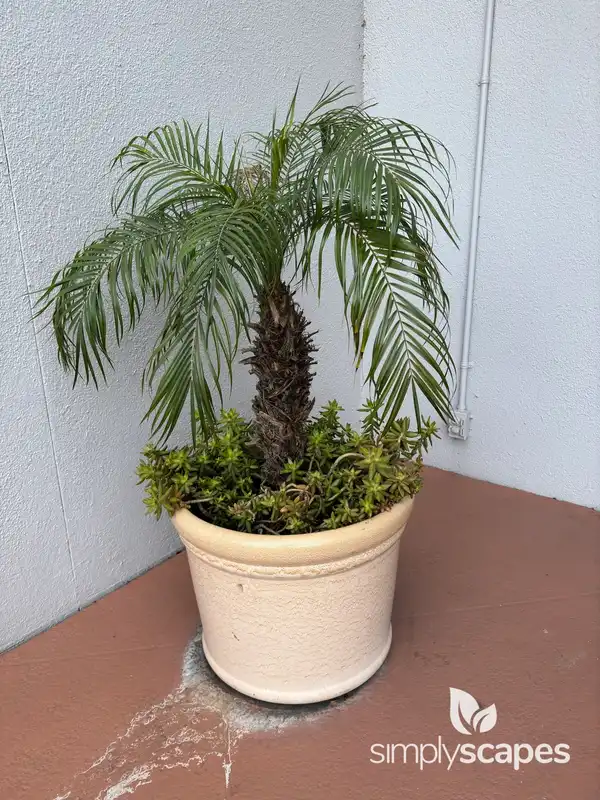
Pygmy Date Palm Tree
Phoenix roebelenii
An elegant, compact palm perfect for adding tropical flair to any space.
- Plant Type
- House Plants & Tropicals
- Width
- 6-8 Ft.
- Height
- 4-12 Ft.
- USDA hardiness zone
- 10 - 11
- Sun requirements
- Full Sun, Part Shade
- Water requirements
- Medium
- Design image count
- 16
Design images (16)


Bring your vision to life
The design images above are drag-and-drop ready — place this plant on a photo of your own yard and see it before you plant it.
Create design onlineAbout Pygmy Date Palm Tree
Phoenix roebelenii, the pygmy date palm, is a compact evergreen palm with a slender trunk and graceful, feather-shaped leaves. It grows about 12 feet tall with a typical 6–8 foot spread, and groups of two to four palms are often planted close together to create a fuller, multi-stem look.
## Size and siting
This palm suits a warm courtyard, entry, patio, or large container where its fine-textured crown has room to arch. UF/IFAS describes it as adaptable to a wide range of soils and cold hardy to USDA Zone 10A; it is also grown in Zone 9B with protection. Its landscape fact sheet gives a broader 4–12 foot height range. The species is not tolerant of salt spray or saline soil. Review the [UF/IFAS pygmy date palm guide](https://ask.ifas.ufl.edu/publication/ST441/pdf) before choosing an exposed coastal site.
## Foliage and flowers
The pinnate leaves have sharp, spine-like basal leaflets, so take care when planting or working beneath the crown. Male and female flowers occur on separate palms in spring; female plants can develop small fruits that darken as they ripen.
## Maintenance
Remove only fully dead fronds. UF/IFAS notes that older leaves with potassium deficiency can still support the palm, so avoid cutting off yellowing leaves prematurely. Provide room for the crown and handle the leaf bases cautiously.