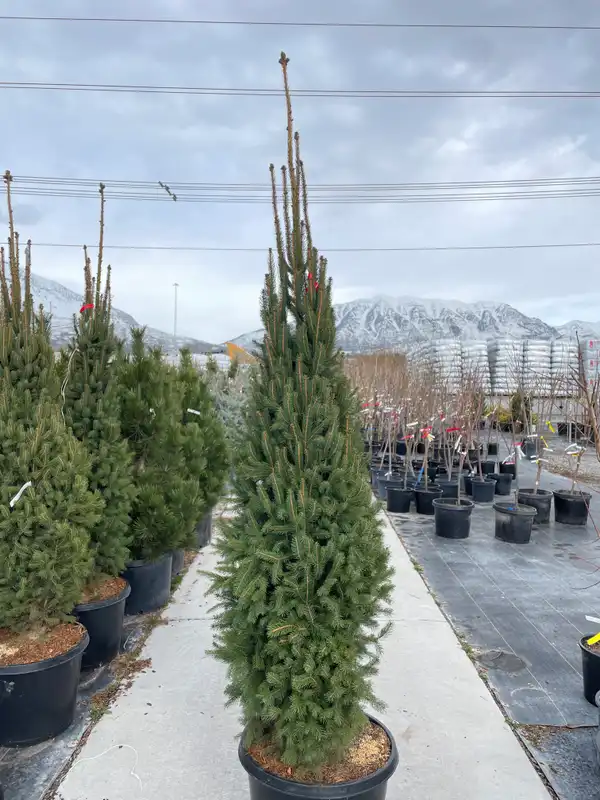
Columnar Norway Spruce Tree
Picea abies 'Cupressina'
An elegant, narrow columnar spruce with dense green foliage, perfect for tight garden spaces.
- Plant Type
- Conifer Trees
- Width
- 6-10 Ft.
- Height
- 20-30 Ft.
- USDA hardiness zone
- 3 - 8
- Sun requirements
- Full Sun
- Design image count
- 2
Design images (2)


Bring your vision to life
The design images above are drag-and-drop ready — place this plant on a photo of your own yard and see it before you plant it.
Create design onlineAbout Columnar Norway Spruce Tree
Picea abies 'Cupressina' is a narrow, columnar Norway spruce with steeply ascending branches and dense, dark green evergreen needles that may look bluish in winter. Its tall vertical outline suits a screen or architectural accent, though published mature-size estimates vary substantially by region and source.
## Growing Conditions
Choose full sun and deep, moist but well-drained soil; the Royal Horticultural Society lists clay, loam, or sand and prefers neutral to acidic soil. Oregon State University describes a tree near 30 feet tall and 4 feet wide, while RHS lists an 8–12 metre height and 2.5–4 metre spread. These differing estimates make room for a broad mature crown prudent. [Oregon State's cultivar profile](https://landscapeplants.oregonstate.edu/plants/picea-abies-cupressina) and [RHS cultivar profile](https://www.rhs.org.uk/plants/84262/picea-abies-cupressina/details) describe the selection.
## Landscape Use
Use its upright form where a narrow evergreen accent or screen is useful. Norway spruce prefers cool-summer climates, moderately moist, well-drained soil, and full sun; it can struggle in heat, dry summers, or waterlogged ground. [NC State Extension's Norway spruce guidance](https://plants.ces.ncsu.edu/plants/picea-abies/) covers these species-level conditions.
## Maintenance
Water regularly while the root system establishes, then adjust irrigation to rainfall and soil drainage. Avoid persistent saturation. RHS reports that routine pruning is not required; remove damaged growth only when needed.