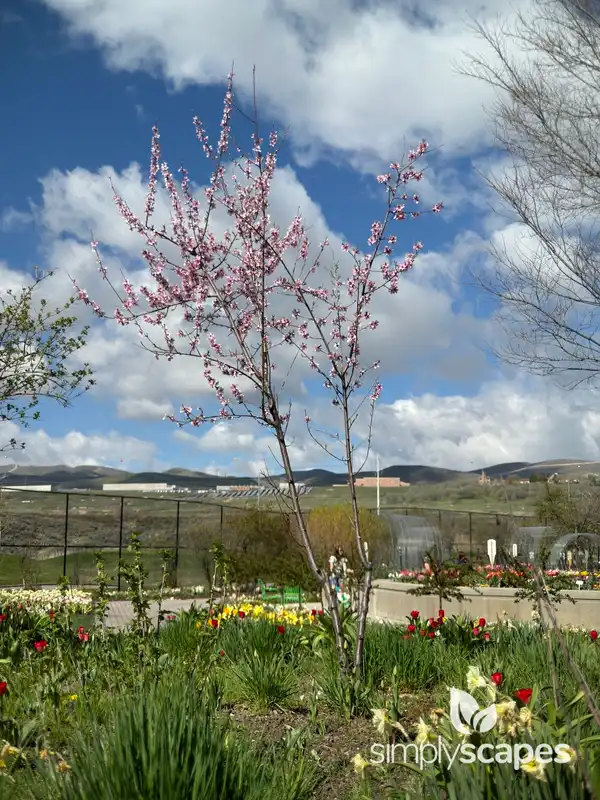
Peach Tree
Prunus persica
A luscious fruit tree with stunning spring blossoms and sweet, juicy summer harvests.
- Plant Type
- Edible Plants
- Width
- 15-25 Ft.
- Height
- 15-25 Ft.
- USDA hardiness zone
- 5 - 9
- Sun requirements
- Full Sun
- Design image count
- 8
Design images (8)


Bring your vision to life
The design images above are drag-and-drop ready — place this plant on a photo of your own yard and see it before you plant it.
Create design onlineAbout Peach Tree
The common peach (Prunus persica) is a deciduous fruit tree in the rose family, native to Asia and represented by many fruit and nectarine cultivars. It develops a rounded crown with upward-growing branches; it may form multiple trunks but can be trained to one, and its showy spring flowers precede summer fruit. [North Carolina State Extension](https://plants.ces.ncsu.edu/plants/prunus-persica/common-name/peach/) gives a general mature range of 15–25 feet tall and wide.
## Site and fruit
Choose full sun and moist, fertile, well-drained, acidic soil for fruit production. The source lists USDA Zones 5–9 and notes that peaches need adequate winter chilling; select a cultivar suited to the local climate. Fruit is edible, but peach seeds and wilted leaves contain compounds that can be poisonous if eaten in quantity.
## Maintenance
Prune to maintain a strong framework, since structural pruning is needed for a healthy crown. Keep the root zone evenly moist while the tree establishes, and avoid waterlogged soil. Peach trees can face numerous insects and diseases, and late spring frost can damage flower buds. Follow local extension guidance for pest monitoring and any spray schedule, and harvest fruit when the selected cultivar reaches maturity.
## Yavapai County — 2025 source scope and care
The [University of Arizona Yavapai County bulletin](https://extension.arizona.edu/sites/default/files/2025-03/FirewisePlants3-14-2025.pdf), page 1, lists Fruit (apples, pears, peaches, cherry) with the botanical cell (no botanical name supplied) and form T. It places this entry in its fire-resistant list. The matched catalog name is Prunus persica. Four named fruit groups are represented separately by unselected Malus domestica (apple), Pyrus communis (pear), Prunus persica (peach) and Prunus avium (cherry). The bulletin does not name these species or individually assess their cultivars; the row remains a qualified common-group match.
Source form codes: C=groundcover, G=grass, P=perennial, S=shrub, T=tree and V=vine. Printed names and form codes can include source spelling errors or historical taxonomic treatments; the source wording is retained separately from the catalog name and plant-specific habit.
The bulletin states that resistant plants require irrigation and frequent maintenance. It describes low shrubs or clean taller shrubs with little dead material. Maintain suitable moisture and spacing, remove dead growth and avoid continuous fuel; a regional list does not establish every selection's performance or local cold hardiness.
No plant is fireproof. Keep this Yavapai classification separate from Arizona UA, Utah, New Mexico, Idaho, Colorado and other source ratings and their placement, moisture and maintenance conditions.
## New Zealand FENZ — qualified printed-name context
The [Fire and Emergency New Zealand directory](https://www.checkitsalright.nz/reduce-your-risk/low-flammability-plants) contains fenz-main-398, in its main directory table, pairing Prunus persica with the common label Flowering cherry and the printed band Moderate. This association preserves that exact published tuple. Source P.persica/Flowering cherry conflicts with peach identity; Kanzan is a flowering-cherry candidate from the adjacent warning conflict, not an automatic band rotation. The published band is not rotated to a neighboring row or to the plant suggested by the common name.
This qualified documentary association does not correct the source, resolve which material the compiler intended, authenticate a cultivar or genotype, verify biological fire performance, or independently assign the common label to this catalog identity. No source dimensions, hardiness, origin, life history, use or other categorical traits are transferred into this profile. Each separate table entry and its evidence role remains distinct.
Follow local fire guidance and site restrictions. A source directory entry and its tag do not guarantee fire performance; maintain suitable clearance and remove dead or dry vegetation.
[Independent identity reference](https://powo.science.kew.org/taxon/1212858-2): Kew accepts Prunus persica as a distinct species; this existing unselected peach profile is retained.