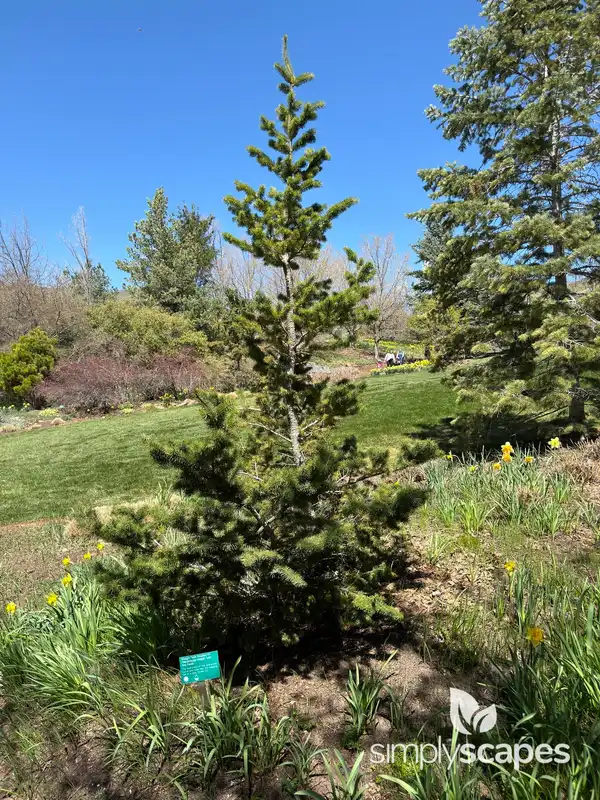
Douglas Fir Tree
Pseudotsuga menziesii
One of the world's tallest evergreens, offering lush foliage and iconic trident-shaped cones.
- Plant Type
- Conifer Trees
- Width
- 12-20 Ft.
- Height
- 40-70 Ft.
- USDA hardiness zone
- 4 - 6
- Sun requirements
- Full Sun, Part Shade
Bring your vision to life
The design images above are drag-and-drop ready — place this plant on a photo of your own yard and see it before you plant it.
Create design onlineAbout Douglas Fir Tree
Douglas-fir (*Pseudotsuga menziesii*) is a large evergreen conifer with a narrow pyramidal shape when young that becomes more columnar with age. Its flat needles are dark green to blue-green and aromatic when crushed, while its hanging cones have distinctive three-pointed bracts. Coastal and Rocky Mountain forms differ in foliage and hardiness.
## Landscape Use
[NC State Extension](https://plants.ces.ncsu.edu/plants/pseudotsuga-menziesii/) describes cultivated trees around 40–80 feet tall and recommends full sun in moist, well-drained, organically rich soil. [Oregon State University](https://landscapeplants.oregonstate.edu/plants/pseudotsuga-menziesii) reports hardiness variation between coastal and Rocky Mountain forms. Plant in acidic to neutral soil and allow generous room. Douglas-fir is valued for timber and Christmas trees and is often more at home in woodland-scale settings than in a small yard.
## Maintenance
Keep the root zone evenly moist, especially during dry periods, because the tree is drought-intolerant. Avoid routine topping; pests such as bark beetles, aphids and mites may occur.
## Yavapai County — 2025 source scope and care
The [University of Arizona Yavapai County bulletin](https://extension.arizona.edu/sites/default/files/2025-03/FirewisePlants3-14-2025.pdf), page 3, lists Douglas Fir with the botanical cell Pseudotsuga menziesii and form T. It places this entry in its fire-prone list. The matched catalog name is Pseudotsuga menziesii.
Source form codes: C=groundcover, G=grass, P=perennial, S=shrub, T=tree and V=vine. Printed names and form codes can include source spelling errors or historical taxonomic treatments; the source wording is retained separately from the catalog name and plant-specific habit.
The bulletin warns that fire-prone plants can ignite readily and burn intensely, and should be removed or aggressively maintained when near a home, road or driveway. For native trees it calls for removing dead material, keeping limbs out of the lower 6–10 feet and clearing shrubs beneath the canopy. For other fire-prone natives it calls for isolated stands more than 30 feet from structures. Apply current local requirements and pruning suited to the identified plant.
No plant is fireproof. Keep this Yavapai classification separate from Arizona UA, Utah, New Mexico, Idaho, Colorado and other source ratings and their placement, moisture and maintenance conditions.