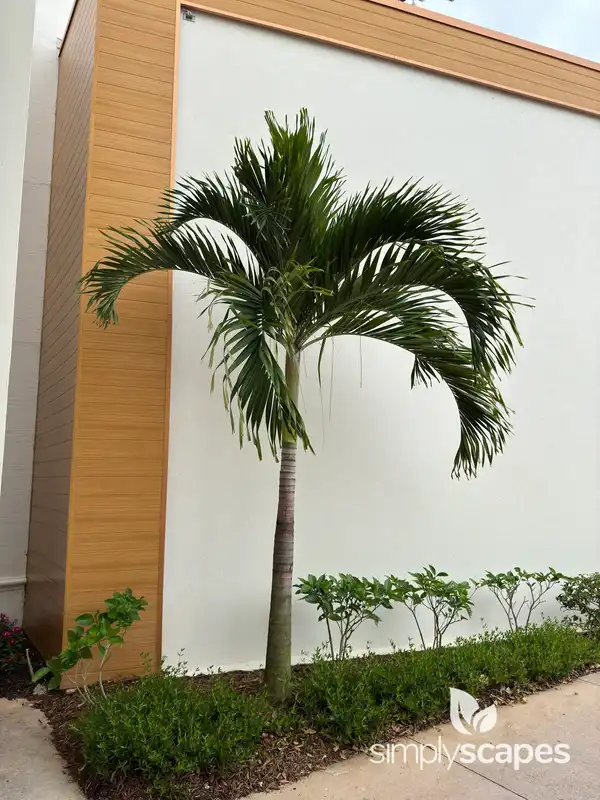
Cuban Royal Palm
Roystonea regia
A majestic, fast-growing palm with a smooth, concrete-like trunk.
- Plant Type
- House Plants & Tropicals
- Width
- 20-30 Ft.
- Height
- 60-100 Ft.
- USDA hardiness zone
- 10 - 11
- Sun requirements
- Full Sun, Part Shade
- Water requirements
- Moderate
- Design image count
- 25
Design images (25)


Bring your vision to life
The design images above are drag-and-drop ready — place this plant on a photo of your own yard and see it before you plant it.
Create design onlineAbout Cuban Royal Palm
Roystonea regia, the Cuban Royal Palm, is a large, solitary palm with a smooth gray trunk and glossy green crownshaft. It bears long, feather-like fronds, cream-colored flowers and dark fruit eaten by birds. Mature size estimates vary: UF/IFAS reports 50–70 ft tall and 20–25 ft wide, while Singapore’s NParks profile gives a maximum height of 15–25 m.
## Form and landscape use
This fast-growing palm is used along avenues, roadsides, parks and other spacious tropical sites. Its self-cleaning fronds drop as whole leaves, so the large canopy should be kept away from busy paths, parked vehicles and buildings. The crownshaft and feathered crown create a strong vertical silhouette.
## Site
UF/IFAS notes that established palms tolerate drought and that the species grows well in wet soils. NParks recommends full sun, moderate water, fertile loamy, well-drained soils and describes it as salt-spray tolerant. The palm also produces heavy fruiting clusters that birds disperse.
## Maintenance
Give the palm room for its tall crown and falling fronds, water regularly while it establishes, and avoid salt accumulation in the root zone. Watch for nutrient deficiency symptoms, especially on older leaves. See [UF/IFAS Extension](https://ask.ifas.ufl.edu/publication/ST574) and the [NParks species profile](https://www.nparks.gov.sg/florafaunaweb/flora/2/6/2682).