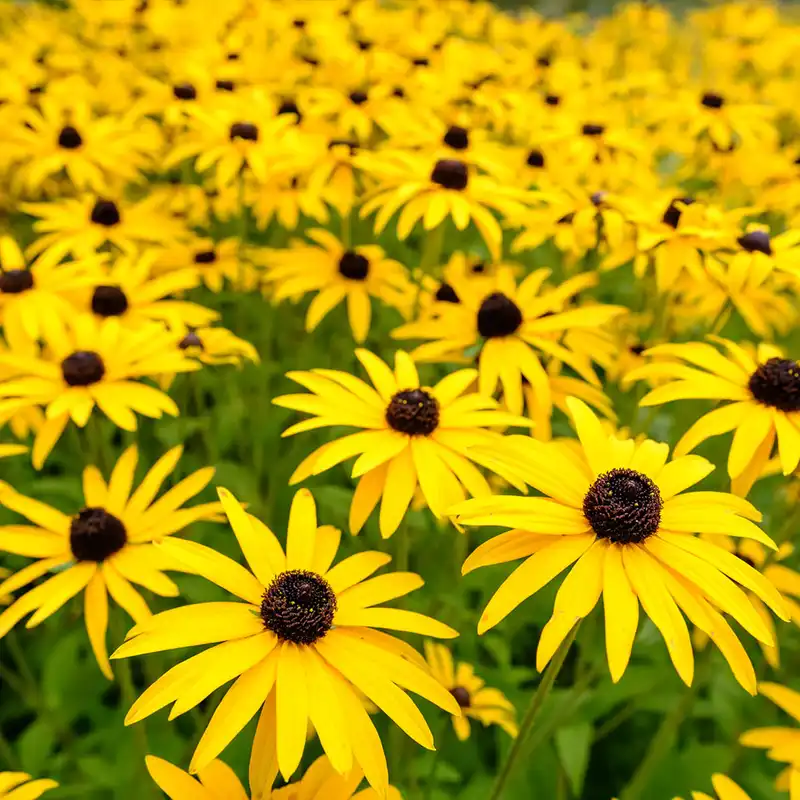
Black-Eyed Susan (Rudbeckie hirta)
Rudbeckia hirta
A fast-growing, upright biennial or short-lived perennial with yellow to orange flowers.
- Plant Type
- Perennials & Annuals
- Width
- 18-24 In.
- Height
- 12-24 In.
- USDA hardiness zone
- 3 - 10
- Sun requirements
- Full Sun, Part Shade
- Water requirements
- Keep soil moist and well-drained; water during establishment and extended dry spells.
- Design image count
- 5
Design images (5)


Bring your vision to life
The design images above are drag-and-drop ready — place this plant on a photo of your own yard and see it before you plant it.
Create design onlineAbout Black-Eyed Susan (Rudbeckie hirta)
Black-eyed Susan (*Rudbeckia hirta*) is a fast-growing, upright biennial or short-lived perennial with hairy stems and yellow-to-orange rays around a dark center. The [North Carolina Extension Plant Toolbox](https://plants.ces.ncsu.edu/plants/rudbeckia-hirta/) describes flowers from midsummer into fall, freely self-seeding plants, and foliage that forms a spring rosette.
## Growing conditions
Grow it in full sun or partial shade in moist, well-drained clay, loam, or sandy soil. North Carolina Extension lists USDA zones 3–8 and notes that the species attracts butterflies and other pollinators; mature size and flowering can vary across this broad species.
## Garden use
Use it in small groups in a border, naturalized area, or pollinator planting. Its open, upright form fits informal beds, and the long flowering period supplies cut flowers and later seed for songbirds.
## Maintenance
Remove spent flowers to encourage continued bloom and limit unwanted seedlings. Allow some seed heads to remain for birds, and water during establishment or extended dry weather.
## Inland West — source row reconciliation
PDF page 19 (printed 17), General list: “Rudbeckia hirta” / “black-eyed susan”. Exact source species or reconciled historical spelling/synonym; unselected record used.
## Inland West — 2005 source scope and care
The [University of Idaho Station Bulletin 67, January 2005](https://www.uwyo.edu/barnbackyard/_files/documents/resources/mullenfire/protectinghomeswildfire.pdf) includes this taxon in its plant suggestions. The publication says the list is not exhaustive and no plant is fireproof; pruning, watering, plant condition and landscape arrangement matter more than selection alone. Choose for slope, aspect, hardiness and rainfall, and keep this association separate from numerical Idaho BLM scores and other regional ratings.
Its landscape guidance describes a treated landscape extending at least 100 feet from the home, with greater distances on steep or windy sites. Separate tree crowns by 10–15 feet; keep foundation plantings low, well watered and free of dead material, eliminate ladder fuels and use separated planting groups with nonflammable breaks. Maintain irrigation, trim turf and remove dry debris. The same species can behave differently with water stress or accumulated dead growth; verify current local guidance and suitability.
## Pacific Northwest — PNW 590 (2023): Black-eyed Susan
The [perennials-50 profile](https://extension.oregonstate.edu/gallery/fire-resistant-plant-profiles-perennials) prints Rudbeckia fulgida or Rudbeckia hirta. Rudbeckia fulgida or Rudbeckia hirta: R. hirta is an exact second option; the first option R. fulgida has a separately mapped narrower var. fulgida representative. Keep both identities and the lower-rank qualification. Rudbeckia hirta: Explicit OR-option identity retained independently of the other option.
Source care: Low water use; Full sun. Keep R. hirta separate from R. fulgida. The source describes hirta as biennial and fulgida as perennial; this source observation is not a universal lifecycle assignment.
Profile reference data: Height: 18-24 inches; Spread: 24 inches; USDA hardiness zones: 4–9; Flowers: golden yellow, with a black center; Bloom time: June–September. These are profile-level source values, not independent measurements of each named example or edits to this record's scalar fields. Native-form availability and general wildlife/deer observations do not automatically establish cultivar attributes.
The [2023 guide](https://extension.oregonstate.edu/catalog/pnw-590-fire-resistant-plants-home-landscapes) requires healthy, adequately watered plants and removal of dead/spent material. Keep the first 5 feet from the home free of plants. In the 5–30-foot zone separate plant groups by at least 10 feet, farther on slopes; avoid continuous rows and ladder fuels and keep tree branches at least 15 feet from the home. This is regional source scope, not a numerical flammability score or a claim of fireproofness. Other regional ratings and older PNW editions remain separate.