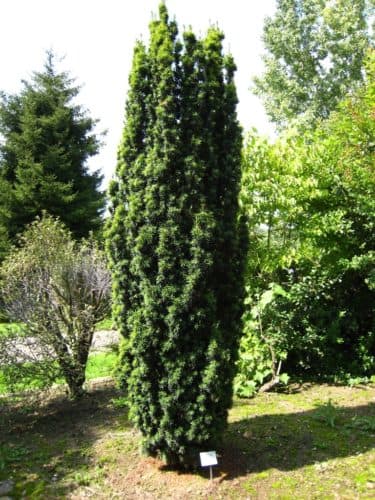
Fastigiata Columnar English Yew
Taxus baccata 'Fastigiata'
A classic, columnar evergreen perfect for formal hedges and vertical accents.
- Plant Type
- Conifer Trees
- Width
- 4-8 Ft.
- Height
- 15-30 Ft.
- USDA hardiness zone
- 6 - 9
- Sun requirements
- Full Sun, Part Shade, Full Shade
- Water requirements
- Moderate
- Design image count
- 6
Design images (6)


Bring your vision to life
The design images above are drag-and-drop ready — place this plant on a photo of your own yard and see it before you plant it.
Create design onlineAbout Fastigiata Columnar English Yew
Fastigiata Columnar English Yew is the upright, narrow-growing form of Taxus baccata ‘Fastigiata’. Its rigid ascending branches and evergreen needles make a vertical accent where a broad tree would take too much room.
## Identification
Oregon State University describes this selection as narrowly columnar or spindle-shaped, with a published garden range of 15–30 ft tall and 4–8 ft wide. The [OSU Landscape Plants profile](https://landscapeplants.oregonstate.edu/plants/taxus-baccata-fastigiata) also notes that fastigiata selections may vary in how narrowly they grow. Keep this named form distinct from the separately named Fastigiata Robusta.
## Site
It grows in sun or shade and is suited to clipped hedges, screening, or use as a vertical specimen. Yews tolerate pruning and can be grown in well-drained garden soil; choose a location with room for the eventual spread. The evergreen canopy provides year-round structure, while female plants may bear red arils. All parts of yew are poisonous if eaten.
## Maintenance
Water regularly while establishing, then adjust irrigation to soil and weather. Trim lightly or shear to maintain a formal column, and remove only the growth needed to preserve the intended shape. Wear gloves and dispose of clippings safely because yew foliage and seeds are toxic.