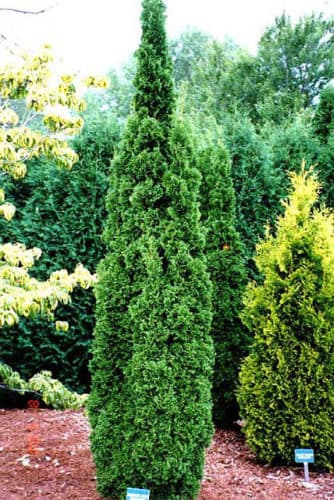
Degroots Spire Arborvitae Tree
Thuja occidentalis 'Degroot's Spire'
Slow-growing, narrow evergreen for vertical structure and screening.
- Plant Type
- Conifer Trees
- Width
- 4–8.2 Ft.
- Height
- 15–39.4 Ft.
- USDA hardiness zone
- 3 - 8
- Sun requirements
- Full Sun, Part Shade
- Water requirements
- Moderate
- Design image count
- 5
Design images (5)


Bring your vision to life
The design images above are drag-and-drop ready — place this plant on a photo of your own yard and see it before you plant it.
Create design onlineAbout Degroots Spire Arborvitae Tree
Thuja occidentalis ‘Degroot’s Spire’ is a slow-growing evergreen conifer with a narrow, columnar outline and twisted sprays of scale-like foliage. Its leaves are green, can take on purple tones in winter, and have a fruity fragrance when crushed. [RHS plant profile](https://www.rhs.org.uk/plants/241059/thuja-occidentalis-degroots-spire/details) · [North Carolina Extension’s plant toolbox](https://plants.ces.ncsu.edu/plants/thuja-occidentalis-degroots-spire/).
## Form and Siting
Use it as a vertical accent, specimen, or narrow screen where its mature width can be accommodated. North Carolina Extension lists a mature height of 15–30 feet and width of 4–5 feet; the RHS profile gives a height range of 8–12 metres and a spread of 1.5–2.5 metres. These published ranges differ, so reserve room for a tall tree with a spread that may approach 8 feet. The slow rate of growth makes it more suitable for lasting structure than a quick screen.
## Growing Conditions
Plant in full sun or partial shade in moist, well-drained soil. The RHS lists chalk, clay, loam, and sand, while North Carolina Extension lists clay, loam, and sand. Protect young trees from drying winds, especially during establishment.
## Maintenance
RHS notes that routine pruning is not required. Water during extended dry periods while the root system is establishing, and give the mature column room to keep its natural outline.