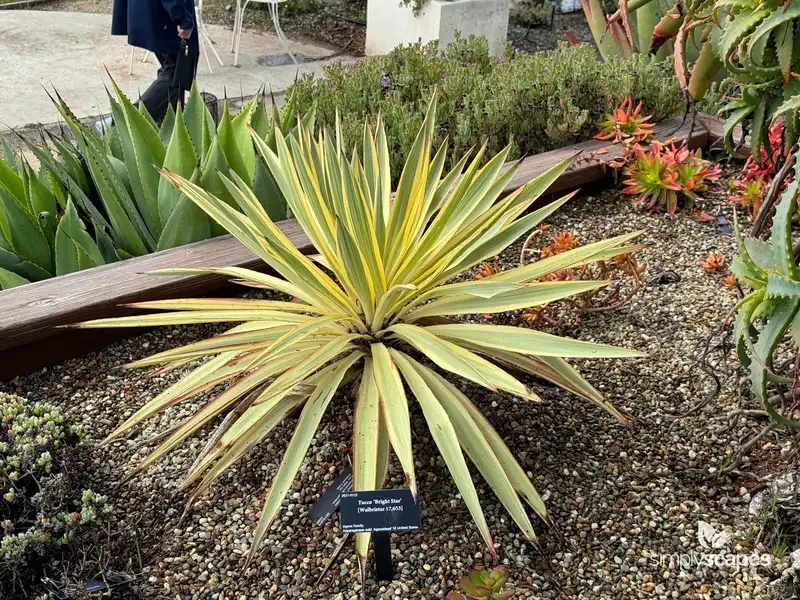
Yucca Plants
Yucca
A varied genus ranging from compact rosette-forming plants to woody, tree-like species with tall flower panicles.
- Plant Type
- Succulents
- Width
- 2-15 Ft.
- Height
- 3-30 Ft.
- USDA hardiness zone
- 4 - 11
- Sun requirements
- Full Sun, Part Shade
Bring your vision to life
The design images above are drag-and-drop ready — place this plant on a photo of your own yard and see it before you plant it.
Create design onlineAbout Yucca Plants
Yucca is an accepted genus in Asparagaceae, native to North and Central America and Bermuda. Kew’s genus description characterizes many yuccas as large, coarse plants, often with woody trunks and tree-like forms; rigid, narrow leaves cluster near trunk or branch tips, and flowers are white or creamy in large terminal panicles.
### Garden Use
Species differ in mature shape and size, so choose a Yucca by its species-level dimensions and local hardiness. Their bold foliage and high flower clusters can provide a strong architectural specimen where the selected species fits the site.
## Maintenance
Use the selected species’ guidance for sun, soil, water, pruning, and winter care; these requirements vary across the genus. [Kew Plants of the World Online](https://powo.science.kew.org/taxon/urn:lsid:ipni.org:names:30003895-2) describes the accepted genus, range, morphology, and classification.
## Napa County Firewise source
[Napa County](https://www.napacounty.gov/3373/Defensible-Space-Firewise-Planting) lists yucca (*Yucca* spp.) among suggested Firewise plants. This genus-level entry reflects the source's broad listing; it does not establish that every species or cultivar was individually assessed. The county emphasizes site selection and maintenance, and no plant is fireproof.
The 2025 Yavapai County guide lists Yucca at genus scope among fire-resistant plants. The source does not individually assess every species or cultivar; follow its placement, irrigation and maintenance guidance.
## Yavapai County — 2025 source scope and care
The [University of Arizona Yavapai County bulletin](https://extension.arizona.edu/sites/default/files/2025-03/FirewisePlants3-14-2025.pdf), page 2, lists Yucca with the botanical cell Yucca and form P, S. It places this entry in its fire-resistant list. The matched catalog name is Yucca.
Source form codes: C=groundcover, G=grass, P=perennial, S=shrub, T=tree and V=vine. Printed names and form codes can include source spelling errors or historical taxonomic treatments; the source wording is retained separately from the catalog name and plant-specific habit.
The bulletin states that resistant plants require irrigation and frequent maintenance. It describes low shrubs or clean taller shrubs with little dead material. Maintain suitable moisture and spacing, remove dead growth and avoid continuous fuel; a regional list does not establish every selection's performance or local cold hardiness.
No plant is fireproof. Keep this Yavapai classification separate from Arizona UA, Utah, New Mexico, Idaho, Colorado and other source ratings and their placement, moisture and maintenance conditions.
## Inland West — source row reconciliation
PDF page 19 (printed 17), General list: “Yucca spp” / “yucca”. Scoped representative of the printed genus or group under General list; the source does not name or individually assess every species, hybrid or cultivar.
## Inland West — 2005 source scope and care
The [University of Idaho Station Bulletin 67, January 2005](https://www.uwyo.edu/barnbackyard/_files/documents/resources/mullenfire/protectinghomeswildfire.pdf) includes this taxon in its plant suggestions. The publication says the list is not exhaustive and no plant is fireproof; pruning, watering, plant condition and landscape arrangement matter more than selection alone. Choose for slope, aspect, hardiness and rainfall, and keep this association separate from numerical Idaho BLM scores and other regional ratings.
Its landscape guidance describes a treated landscape extending at least 100 feet from the home, with greater distances on steep or windy sites. Separate tree crowns by 10–15 feet; keep foundation plantings low, well watered and free of dead material, eliminate ladder fuels and use separated planting groups with nonflammable breaks. Maintain irrigation, trim turf and remove dry debris. The same species can behave differently with water stress or accumulated dead growth; verify current local guidance and suitability.
## Pacific Northwest — PNW 590 (2023): Yucca
The [broadleaf-evergreens-12 profile](https://extension.oregonstate.edu/gallery/fire-resistant-plant-profiles-broadleaf-evergreens) provides this source context. Primary heading: Yucca species. Exact source genus scope; no individual species/cultivar testing inferred.
Source care: Low water use; Full sun. This is a genus-level source profile for sword-leaved plants. It does not independently establish suitability of every Yucca species, selection or tree form.
Profile reference data: Height: 2–4 feet; Spread: 2–4 feet; USDA hardiness zones: 4–10; Flowers: white; Bloom time: June–July. These are the publication's profile-level reference values; they are not independent measurements of each named example or a change to this catalog record's scalar fields. Availability of native forms, pollinator use and deer resistance remain source-scope statements, not automatic attribute tags.
The [2023 guide](https://extension.oregonstate.edu/catalog/pnw-590-fire-resistant-plants-home-landscapes) requires healthy, adequately watered plants and removal of dead/spent material. Keep the first 5 feet around the home free of plants; in the 5–30-foot zone separate planting groups by at least 10 feet, farther on slopes. Avoid continuous rows and ladder fuels, and keep tree branches at least 15 feet from the home. Source association is not a laboratory flammability score or a claim of fireproofness. This paragraph identifies 2023 scope; older PNW associations and other regional ratings remain separate.